
An auditory learning style is a preference for taking in information through spoken language, such as lectures, discussions and audio recordings, not a fixed type of brain that only learns by hearing. The blunt version of the answer is that the preference is real and common, while the claim that audio produces better learning has never held up, and a 2024 meta-analysis of the learning-styles literature found only 21 studies rigorous enough to test whether matching instruction to a preferred style changes anything at all.
So why does the idea keep arriving dressed as a diagnosis, complete with a traits quiz and a list of jobs that suit your ears?
Because the experience underneath it is genuine. You do follow a spoken explanation more easily than a wall of text. You do remember what your supervisor said in the corridor three weeks ago. Those moments deserve a proper explanation, and the explanation turns out to be more interesting than the label. What they don't prove is the second half of the claim, the part where sound becomes your only efficient channel for learning.
Most definitions of what an auditory learning style is stop at the trait list. This one keeps going: what the label describes, what it can't tell you, how the three classic categories compare on the same criteria, what the experiments found, and a routine you can run on your own notes this week. You'll finish with something a quiz can't give you, which is a way to test whether listening earns its place in your study time.
Table of Contents
- Auditory Learning Style Defined and Why It Matters
- Signs You Lean Toward Learning by Ear
- How Auditory Compares With Visual and Kinesthetic Styles
- What the Research Says About Learning Styles
- When Audio Helps and When to Add Text
- A Revision Routine for Audio Study Notes
- Classroom Tips for Teachers and Tutors
- Start Your Audio Study Routine This Week
Auditory Learning Style Defined and Why It Matters
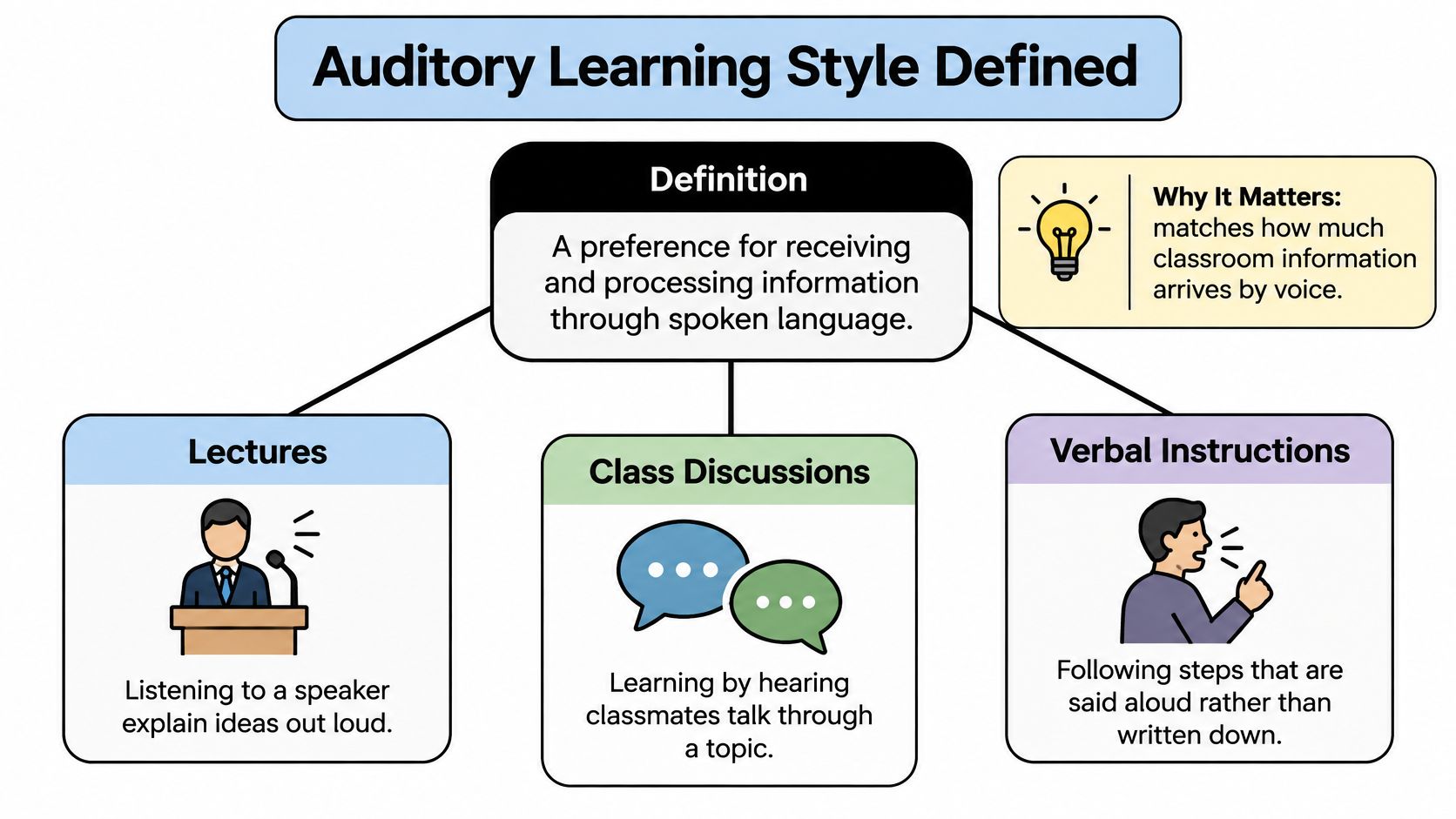
What does it mean to prefer learning by ear? An auditory learning style describes a preference for taking in information through spoken language. The word preference matters: it describes the format that feels comfortable, not proof that listening leads to better learning.
The idea belongs to the broader family of learning styles, which groups people by preferred sensory channel, often auditory, visual, or kinesthetic. A review of research on learning styles traces this framework and examines the evidence behind it.

The door analogy that keeps the idea honest
A preference works like the entrance you tend to use. Perhaps the side door is closer to your bus stop. That habit tells you something about your route, but not what you learn once you are inside.
Audio can feel like an easier entrance because speech carries tone and emphasis, and listening can fit alongside other activities. The learning itself still depends on what happens next: recalling ideas, checking mistakes, and revisiting material. A comfortable format is a starting point, not a measure of what you have learned.
The distinction to keep in mind: preference describes the route into the material. Recall shows what stayed with you.
Why the label still earns its place
Knowing that spoken explanations suit you can help you choose how to begin studying. You might listen to an explanation before working through a manual, or read your own writing aloud to catch phrasing that silent reading misses. Those choices can make study feel more comfortable, but comfort alone cannot show whether the information stuck.
A simple personal test helps: listen to a short explanation, then set it aside and try to recall its main ideas. Compare that with what you remember after reading the same material. The result can guide your study choices without turning a preference into a fixed identity. For another overview of listening as a study format, Rooy Development's audio learning guide discusses how it can fit into a study week.
Signs You Lean Toward Learning by Ear
A strong listening preference usually shows up within a week of ordinary work, no quiz required. Watch for the behaviours rather than the self-description, since people are famously bad at reporting how they learn.
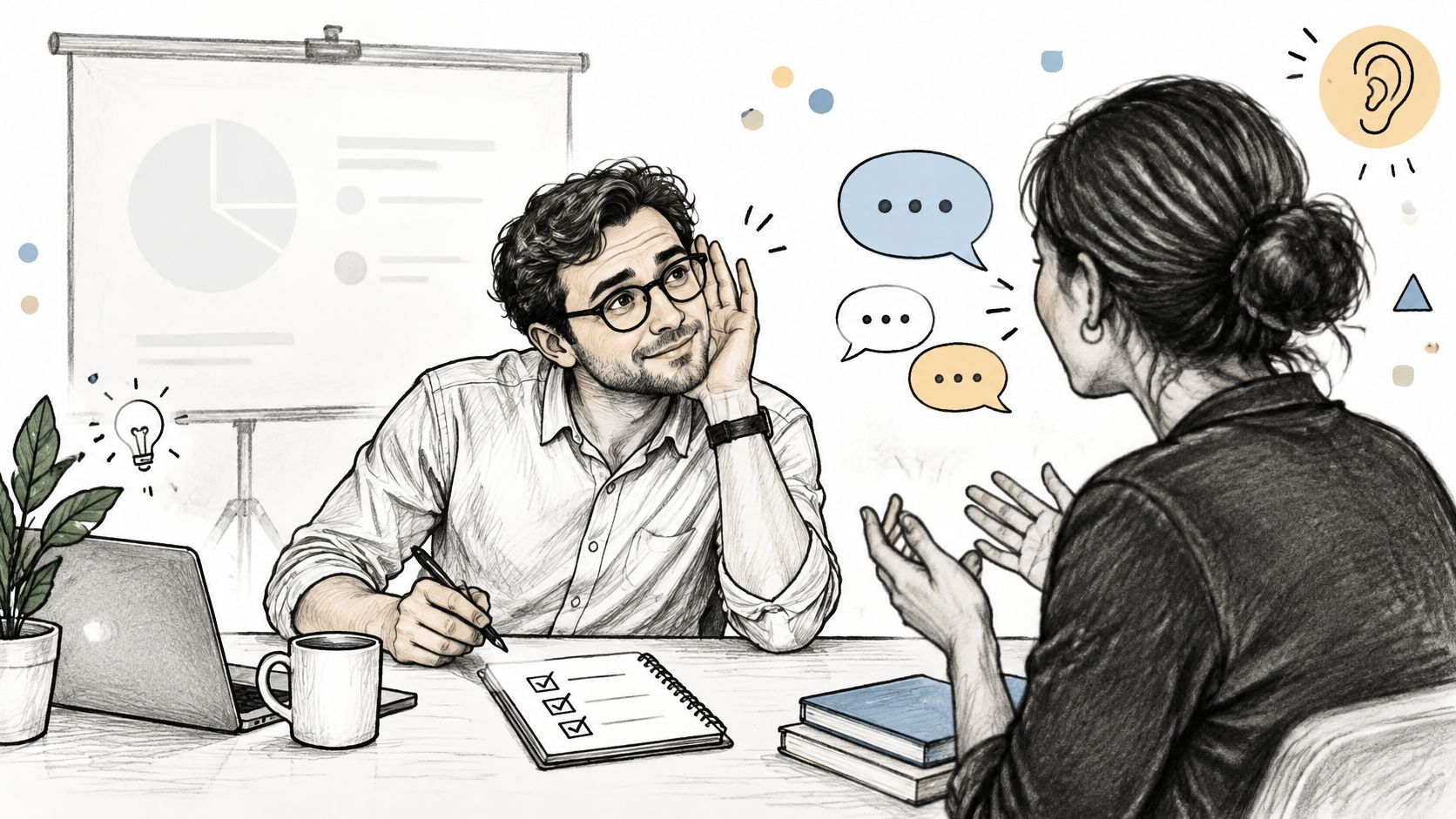

The checklist below is the one worth scanning. Treat every tick as a hint, not a verdict.
- You remember the meeting, not the deck. The argument survives in your memory as something a person said, while the slide numbers blur.
- You read difficult paragraphs aloud. Tax law, statistical method, a contract clause: your lips move and the meaning arrives.
- You check whether an audio version exists before you start. Podcast, recorded lecture, text-to-speech, anything that saves you from a wall of print.
- You talk a problem into shape. Explaining it to a friend, or to the empty kitchen, is how the pieces fall into place.
- You repeat instructions back before you act. Repeating a sequence out loud is your way of holding it.
- A dense page tires you faster than a dense podcast. This is about fatigue, and fatigue is a real usability factor.
Reading the signs without overreading them
Say a student recalls her professor's spoken analogy about supply chains weeks later, but can't summon the diagram from the same lecture. That's a fact about what she attended to. It isn't evidence that her brain rejects diagrams, and it certainly isn't evidence that sound is the only route by which she can learn supply chains.
Plenty of people tick four or five boxes on that list and still learn efficiently from text, especially when the text is well written and the topic is spatial. The honest interpretation of these signs is narrow: they show the format you gravitate toward, not the format that will store the material most reliably.
Hold the checklist as a working hypothesis for one week. Then test it with the delayed-recall comparison described further on, because a habit is not a measurement.
How Auditory Compares With Visual and Kinesthetic Styles
The three classic labels are usually presented as separate species. Put them in the same frame and the pattern looks different.
| Preference label | Typical cues | What the research supports |
|---|---|---|
| Auditory | Likes lectures, discussion, read-aloud text and recordings | Audio is a useful access and review route, but no proof of a unique learning advantage |
| Visual | Likes diagrams, colour-coding, charts and layouts | Visual formats help spatial and diagram-heavy content, which is a task effect rather than a learner type |
| Kinesthetic | Likes hands-on practice, movement and real tasks | Practice improves procedural skill; the benefit comes from the activity, not the learner label |
| Mixed preference | Uses two or more channels depending on the topic | Matching the format to the task is the evidence-based approach |
What each row actually says
The auditory row gets misread constantly. Listening is an efficient way to cover ground while walking, driving or folding laundry, and narrated notes are excellent for definitions and argument structure. What the row can't promise is that audio will store the material better than reading would. Convenience and retention are separate questions, and the first is much easier to win.
Visual preferences point at something more concrete, because diagrams carry information that prose struggles to express. A process flow, a timeline, a labelled cell: these are formats, not faculties. Draw the timeline and comprehension rises for almost everyone, not only for the people who say they're visual.
Kinesthetic preferences tend to describe how skill is built. You get better at pipetting, suturing or soldering by doing it, with feedback, and that's true regardless of which label you picked on a quiz. The activity does the work.
Mixed preference is where many learners land once they stop choosing. You might want audio for a commute, a diagram for a metabolic pathway, and a physical rehearsal for a lab technique, all in the same week.
Why the task beats the label
Notice what each row has in common. The format matters because of what it does to the content, not because of who is holding the textbook. A timeline helps because sequences have shape. A recording helps because speech carries emphasis and because your hands are free. Neither format cares what you called yourself in a survey.
That's why the practical question is never which type of learner am I. It's what does this material need in order to be understood and recalled, and which formats can I supply this week.
What the Research Says About Learning Styles
Does a preference for audio mean you learn more from listening? Researchers have tested this by looking for a specific pattern: people who prefer audio should perform better when taught by audio, while people who prefer visual material should perform better when taught visually. This crossover pattern is called “meshing.” If it does not appear, a preference label does not predict which format will help someone learn.
One study compared college-educated adults' verbal-comprehension aptitude with their learning from a digital audiobook or electronic text. The listening and reading comprehension study found that people whose stated preference matched their assigned format did not comprehend significantly better than those whose preference did not match. Preferring audio did not, on its own, give readers a dependable advantage with audiobooks.
Testing the meshing idea takes more than asking learners which format they like. Researchers need to compare different preference groups across formats, use the same material, and measure learning after a delay. Research on this question has not established a clear, consistent benefit from matching instruction to a preferred style. That leaves a practical distinction: liking audio is useful information about comfort, but it is not proof that audio improves your learning.
Four steps to test the claim on yourself
Try a simple comparison over two study sessions. The goal is to see what you remember, not just which format feels easier.
- Split the material. Choose two sections on the same topic that are similar in length and difficulty. Listen to one and read the other.
- Keep conditions steady. Use the same study time, room, and level of distraction for both sections. If possible, study at the same time of day.
- Wait at least a day. Immediate recall can reflect what felt familiar in the moment. A delay gives you a better sense of what stayed with you.
- Compare recall, not comfort. Answer the same kind of questions for each section and compare how accurately you respond.
Audio may feel effortless because you can listen while doing something else. Ease is a measure of convenience, though, not necessarily of what you will remember. A challenging reading session may leave a stronger memory than a smooth listening session.
Decision rule from your own data: If your delayed quiz score for audio matches or beats your score for text, include listening in your study routine. If it does not, use audio when it is convenient, and start learning unfamiliar material with text.
When Audio Helps and When to Add Text
Audio earns its place in three situations: when the task itself involves sound, when access or convenience is the bottleneck, and when you'd otherwise lose the time completely. It struggles when the content is spatial, numeric or quoted word for word.
| Study task | Audio fit | Pair with |
|---|---|---|
| Reviewing definitions and key terms | High | Recall from memory after each audio segment |
| Pronunciation and language listening | High | Written transcript for checking spelling |
| Long reading assignments during a commute | Medium | Short written summary afterwards |
| Unfamiliar technical terminology | Medium | Synchronised text with highlighting |
| Dense equations, tables and diagrams | Low | Visual inspection of the original material |
| Exam-style problem solving | Low on its own | Written practice problems |
What the caption research adds
Language learners face a decision that the auditory label hides: listen alone, read along, or switch between the two. Recent research on captioned video found a pronounced proficiency effect, with lower-proficiency learners prioritising captions and higher-proficiency learners leaning on the audio, and it reported differences in reading and listening scores across those groups. Reading while listening may improve comprehension compared with listening alone, though that benefit isn't proof of a uniquely auditory advantage. It's proof that two channels can help when one is still under construction.
Start with text when the material is new and dense. Switch to audio for review, and for time you'd otherwise lose to a commute.
Treat listening as one step, not the system
The strongest use of audio is inside a retrieval loop rather than at the front of it. Listen to a short segment, pause, say the idea from memory, then open the source to check the wording and the diagram, then answer an application question with the audio off. That sequence is what separates study from exposure, as Yale's teaching resource on the learning-styles myth explains: exposure opportunities rise during a commute, but exposure isn't encoding.
Accessibility needs push the decision in different directions for different readers. A blind learner benefits from structured navigation and clear document descriptions more than from prettier diagrams. A dyslexic learner often does best with simultaneous highlighting and narration. Screen fatigue points toward audio for the second and third pass, not the first.
The material itself sets limits too. Precise quotations, chemical equations, financial tables and spatial relationships generally need your eyes on the original, because a voice reading a table aloud strips out the alignment that made it meaningful.
A Revision Routine for Audio Study Notes
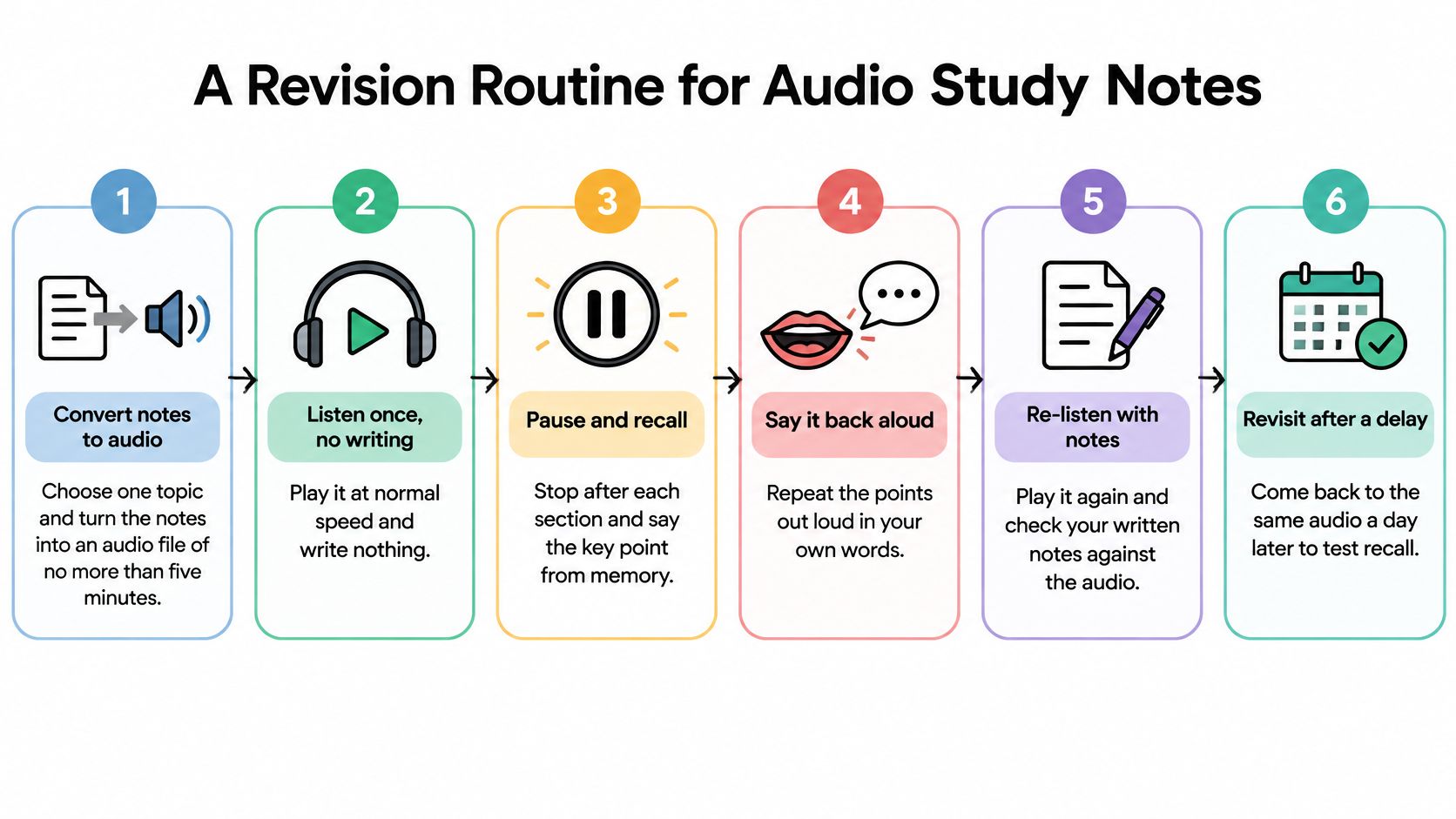
Twenty-five minutes, one topic, one short file. This routine is built so that listening serves retrieval rather than replacing it.
- Convert one topic to audio, five minutes maximum. Keep it short enough to replay without dread. Detailed notes become audio; dense tables stay on paper where they belong.
- Listen once at normal speed with nothing in your hands. No pausing, no notes. You're building a map of the segment, not memorising it.
- Pause and say the main idea out loud. This is the step people skip, and it's the one doing the work. Producing the idea from memory is retrieval; recognising it while it plays is not.
- Check the source notes for exact wording. Correct your version against the original, including any diagram. Errors that survive this step get practised.
- Write three prompts on paper. One definition, one example, one application question. Writing them forces you to decide what matters.
- Re-listen at a slightly faster speed, then answer the prompts blind. Answer with the audio off, in writing. Speed changes are one reason text-to-speech suits this routine, since you can push a familiar passage faster and slow down a hard one.
- Mark what you missed and repeat that section tomorrow. The gap you found today is tomorrow's first task, which is how a delayed repeat strengthens memory instead of just refreshing familiarity.

The four-label note template
Keep one page per topic with four headings, and fill them in this order.
- Concept: the idea in one sentence, written after you've said it aloud, not copied from the audio.
- Say it: a two-line spoken summary you'd give a classmate in the corridor.
- Check it: the exact wording or figure you verified against the source, plus anything you got wrong.
- Apply it: one question you can answer only by using the concept, not by reciting it.
What success looks like
Two days after the last replay, open the page and answer your three prompts without touching the audio. If the definition, the example and the application all come back, listening has earned a place in your week for this kind of material. If the application question collapses while the definition survives, you've learned recognition rather than understanding, and the fix is more written problem solving, not more replays.
For a simple weekly rhythm that pairs well with this loop, Knobee AI's guide to active recall shows how to space self-testing across a week. Alternating spoken summaries with written problem solving is the pattern to keep, since passive replay alone never demonstrates superior learning.
Classroom Tips for Teachers and Tutors
Label students as little as possible and vary formats as much as you can. A class doesn't need to know its learning types. It needs several routes to the same idea.
- Offer two formats for the same content. A spoken explanation plus a one-page written summary means everyone can review what was said, including the student who was half asleep at the back.
- Build in short verbal pauses. Stop every ten minutes and ask students to restate the key idea to a partner. That's active recall wearing a discussion costume, and it costs ninety seconds.
- Give recordings a task. If you post an audio explanation, attach two questions to answer afterwards. A replay with no purpose becomes background noise.
- Match the format to the goal. Discussion and read-aloud work when the goal is speaking, listening or argument. Diagrams do the job when the goal is structure, sequence or hierarchy.
- Use the three-step explanation cycle. A tutor teaching a historical sequence explains it aloud, asks students to sketch the timeline, then asks them to explain it back in their own words. Speech, image, speech.
Judge a format by a short quiz two days later, not by a show of hands at the end of class. Surveys measure preference. Quizzes measure retention.
Start Your Audio Study Routine This Week
Start the routine now, and let delayed quiz scores decide whether it stays. That's the whole recommendation. The sessions will probably feel pleasant, and pleasantness is the least trustworthy signal you have.
TTS Pro covers the conversion step: smart scan turns printed pages, notes or a printed book into audio, and you can choose from several voices and set a listening speed that matches how dense the material is. That matters for students working from paper handouts and for anyone staring down a long PDF at the end of a workday.
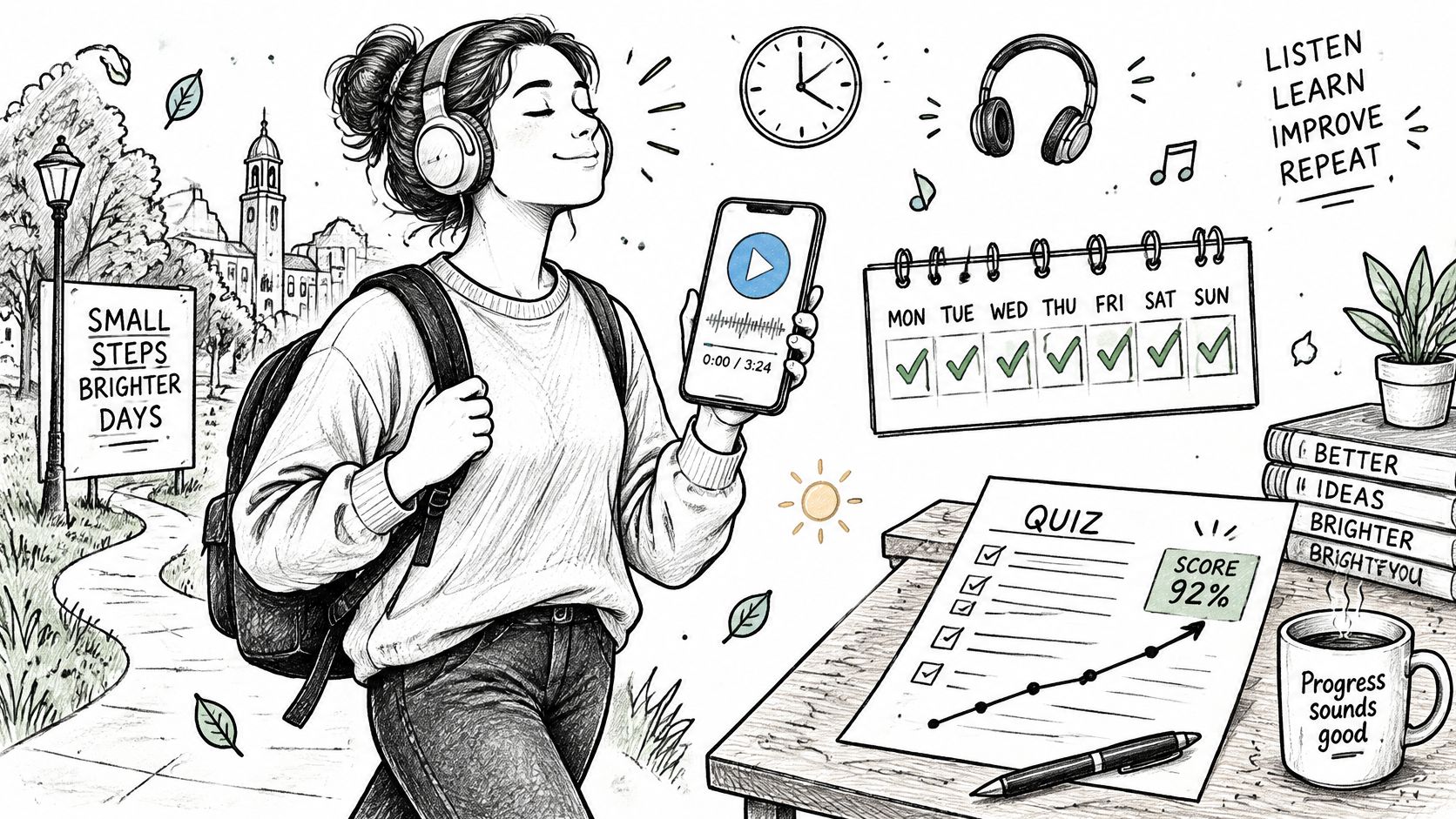

Three steps to run this week
- Convert one set of notes or one article tonight. Pick a topic you're actively being tested on, not a folder you haven't opened since September.
- Run the 25-minute routine for five days. Same topic, changing segments, with the pauses and the written prompts intact.
- Compare against a text-only session on similar material. Use the delayed-quiz comparison from earlier, and score it a day later.
How to read the result
If recall holds or improves, listening has a permanent role: first pass for some material, review for all of it. If it doesn't, the format isn't wasted. Keep audio for commuting, for the gym, for a second pass over material you've already understood, and stop counting it as primary study time.
TTS Pro turns the text you already study from into audio you can hear anywhere, including PDFs, EPUB files, web articles and scanned pages from a printed book. It runs on iOS and Android, plays through a commute or a workout without interruption, and lets you switch voices and adjust speed to suit the material. Convert one set of notes at TTS Pro this week, then let your own delayed quiz decide how much of your study week audio deserves.


No Comments
Leave a comment Cancel