
You've reread your lecture notes, highlighted the difficult passages, and stayed up later than you planned. The material looks familiar. Then you close the notebook and try to explain a central concept, and you can't get much further than its name.
That's the limitation of studying by recognition. Seeing an explanation isn't the same as producing it, defending it, or using it to solve an unfamiliar problem. Active learning asks you to think, speak, write, test, and teach, rather than only receive information.
The evidence is substantial, although its scope matters. In a synthesis of 225 undergraduate STEM studies, Freeman and colleagues' PNAS meta-analysis found that examination scores were approximately 6% higher with active learning than with traditional lecturing. That doesn't mean every discussion or group project will work equally well. Students still need accurate explanations, suitable questions, and feedback.
Practical rule: Choose an activity by what it makes you think about, not by how busy it keeps you.
A faster lecture note-taking workflow can help you capture material, but your next move matters more: turn those notes into a question, an explanation, or a problem you can attempt without copying.
The following active learning strategies for students combine a concrete activity with an example, an assessment idea, and ways to adjust participation. Text-to-speech audio appears throughout as an accessibility and review option, not as a replacement for independent thinking. You don't need to redesign your entire study routine. Start with a task you can use in your next class or study session.
Table of Contents
- 1. Think-Pair-Share
- 2. Peer Instruction
- 3. Jigsaw Method
- 4. Problem-Based Learning (PBL)
- 5. Flipped Classroom
- 6. Reciprocal Teaching
- 7. Socratic Seminar
- 8. Retrieval Practice with Low-Stakes Quizzing
- 9. Gallery Walk
- 10. Audio-Based Review and Student-Created Podcasts
- How the 10 Active Learning Strategies Compare at a Glance
- Turning Active Learning into Your Next Study Session
1. Think-Pair-Share
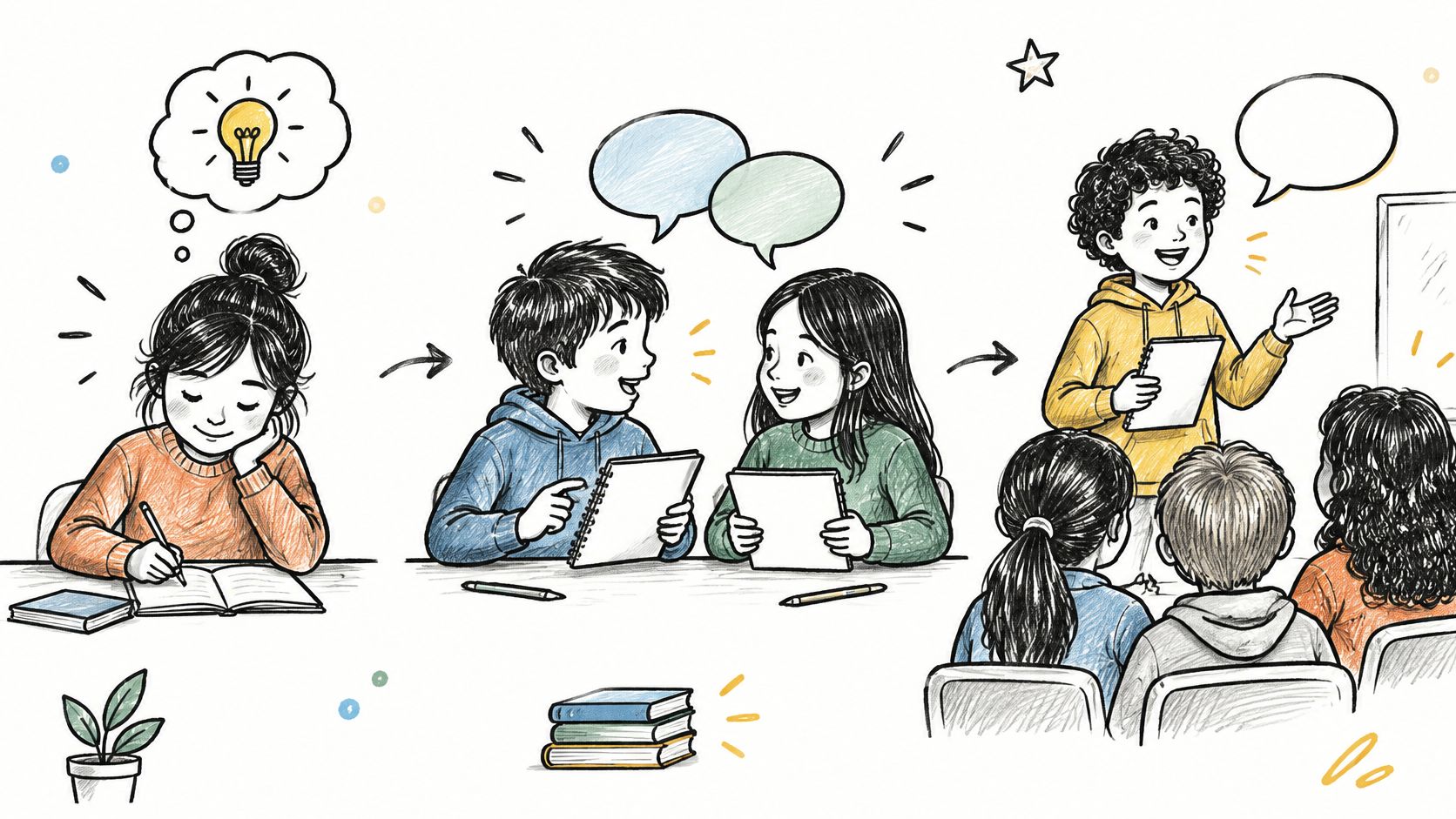
A biology instructor asks why a plant kept under bright light might still grow poorly when carbon dioxide is limited. Instead of calling on the quickest volunteer, the instructor asks everyone to write an explanation, compare it with a partner's, and then contribute to the class discussion.
That's Think-Pair-Share: individual preparation before collaborative reasoning. The written thinking stage is essential. Without it, a confident partner can supply the answer before the other student has formed a view.
Use a prompt that requires an explanation, prediction, or choice between plausible alternatives. A factual question with an immediately obvious answer gives partners little to discuss.
- Think independently: Write a claim and the reason behind it before talking.
- Compare reasoning: Identify where your explanations agree and where they conflict.
- Share a revision: Report what you changed or clarified, rather than repeating your original answer.
Assess the Change in Reasoning
Keep the original response, then write a revised explanation after the discussion. For the plant example, check whether the revision connects carbon dioxide to the materials needed for photosynthesis, rather than merely naming it as important.
Assess the reasoning, not agreement with the partner. A changed answer isn't automatically an improved answer. Ask students to identify the evidence or principle that justified their revision.
For differentiation, provide sentence starters such as a claim followed by a reason, or allow a labeled diagram instead of prose. Students with language anxiety can share a prepared written response; students who need additional processing time shouldn't be required to improvise publicly.
Text-to-speech can read the prompt and background passage before the activity. Keep the prompt available in writing so students can revisit its wording without relying on auditory memory.

2. Peer Instruction
Peer instruction starts with disagreement worth investigating. Students answer a conceptual multiple-choice question independently, explain their reasoning to a peer, and then answer again. The instructor withholds the correct answer until students have examined the alternatives.
Consider a physics question about a ball after it leaves someone's hand. The answer choices might represent different explanations of the forces acting on it. Each distractor should reflect a meaningful misconception, not a wording trick.
After the initial vote, partners explain why they selected their answers. If they disagree, each should identify the assumption behind the other person's choice before defending their own. Students then submit another answer with a brief justification.
Don't reveal the answer before the discussion. Once students know the correct option, they can repeat it without resolving the misconception.
Check Understanding Beyond the Vote
Assessment idea: Follow the discussion with a related problem in a different setting. If students discussed a thrown ball, ask them to reason about an object released from a moving vehicle. Require an explanation, because selecting the right letter can conceal a guess.
The trade-off is preparation time. Writing plausible alternatives takes more care than writing a recall question, and an ambiguous stem can turn productive disagreement into frustration. Ask a colleague to check the question before using it for assessment.
For differentiation, collect votes through paper cards, an accessible form, or private written responses rather than requiring a smartphone. Let students prepare their explanation in writing before discussing it, and don't equate fluent speech with conceptual understanding.
Text-to-speech can make the question and options available audibly. Read equations, symbols, and diagrams separately where automated narration would make their meaning unclear.
3. Jigsaw Method
In a jigsaw activity, students study different parts of a topic, consult others working on the same material, and then teach their classmates. The activity works only when students eventually connect those parts into a coherent explanation.
Say a history class is examining a campaign for political reform. Different expert groups analyze speeches, newspaper coverage, legislation, and personal accounts. Students then return to mixed groups and explain what their source contributes, including its limitations.
Give every expert group a clear briefing task. Students need more than permission to read and discuss.
- Identify the central claim: Explain what the material says or demonstrates.
- Select supporting evidence: Mark the passage, example, or observation that supports that interpretation.
- Flag uncertainty: Note what the source leaves unanswered or cannot establish.
- Prepare to teach: Create a concise explanation and a question for classmates.
Make Everyone Accountable for the Whole Topic
Assessment idea: Ask each student to explain a connection between their own source and material taught by someone else. A response about only their assigned section won't show whether they learned from the group.
The main risk is uneven expertise. If an expert misunderstands a source, the misunderstanding can spread. Build in an instructor check before students teach, and provide an accurate shared summary after the exchange.
For differentiation, use accessible texts with comparable intellectual demands rather than assigning struggling readers material that excludes them from the central question. Offer vocabulary support, readable layouts, and a choice between spoken teaching and a prepared written explanation.
Text-to-speech lets students review their assigned passage before the expert discussion. Preserve headings and source labels, and encourage students to check quotations against the written text before presenting them.


4. Problem-Based Learning (PBL)
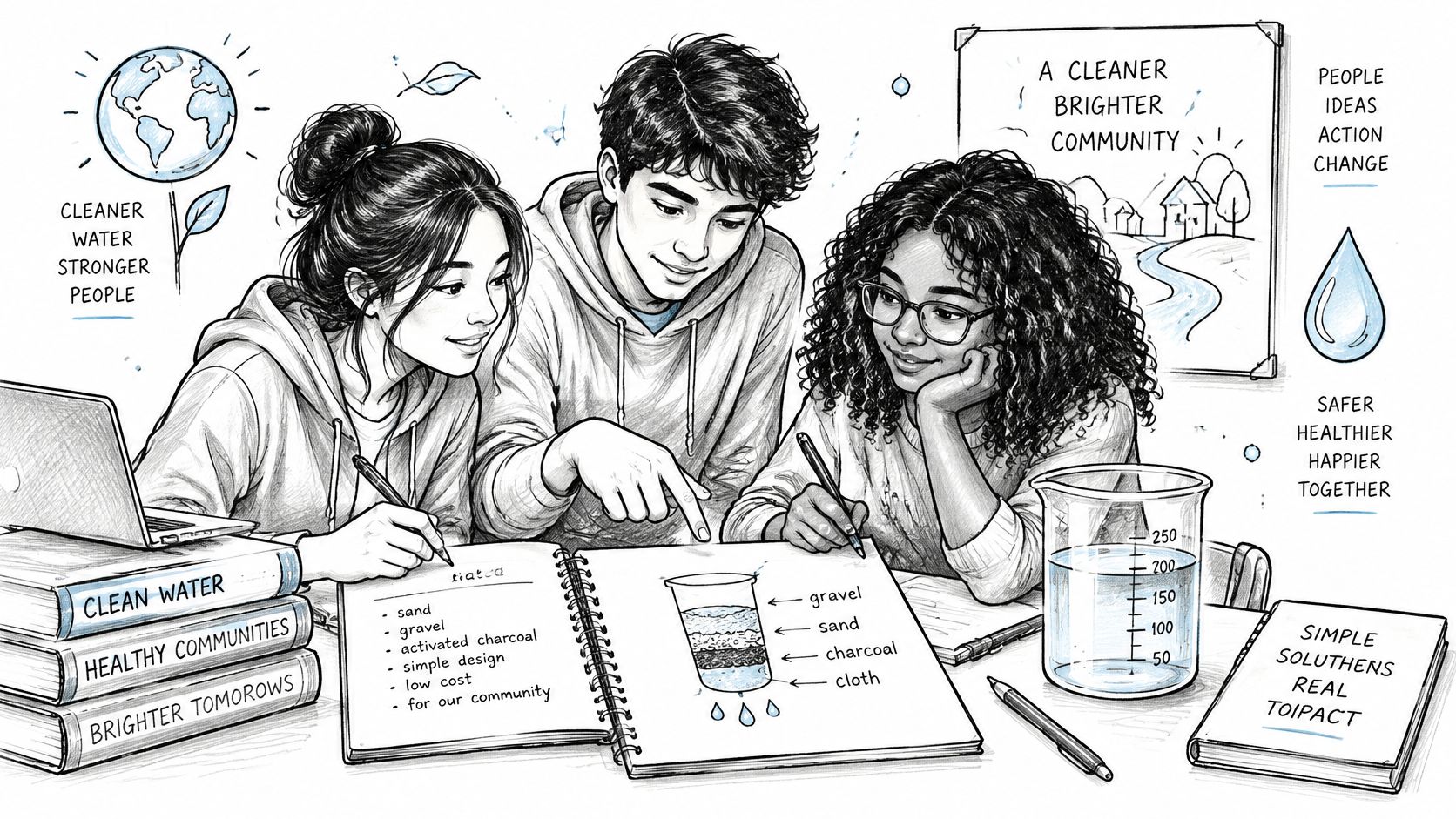
A team is asked to propose a water filtration system for a community with limited maintenance resources. Before choosing equipment, students must identify the contaminants, available materials, operating constraints, and evidence needed to judge whether their proposal is safe.
That's problem-based learning: students investigate a realistic problem and learn relevant concepts while developing a defensible response. It isn't an elaborate project added after the teaching is finished.
Start by separating known facts from assumptions. A useful team document records the problem, available evidence, unresolved questions, and the next investigation each member will complete. After researching, students return to the original problem and revise their proposal.
Assess Decisions, Not Presentation Polish
Assessment idea: Require a decision brief that links each recommendation to evidence and acknowledges an unresolved limitation. Then ask students individually to explain how their proposal would change if a constraint changed, such as reduced maintenance access.
That individual response matters. An attractive group presentation can hide students who haven't understood the underlying concepts.
- Provide boundaries: Specify the scientific principles, documents, or constraints students must address.
- Check progress: Review the problem definition before students commit to extensive research.
- Require justification: Ask why the team rejected a plausible alternative, not only why it likes its chosen solution.
For differentiation, offer research, diagramming, analysis, and presentation roles without permanently assigning students according to perceived ability. Provide a worked example of the decision process if students are new to open-ended problems.
Audio versions of case materials can reduce barriers to accessing long briefs. However, filtration diagrams, numerical tables, and technical specifications still need accessible visual or structured-text alternatives. Listening alone won't make a poorly formatted technical document usable.

5. Flipped Classroom
A flipped classroom changes where initial preparation happens. Students encounter introductory material through a reading, recording, or audio explanation before class, then use supported class time to solve problems and discuss difficult ideas.
Moving a lecture into a video doesn't automatically make learning active. The useful change is what students can do afterward, with feedback available when they get stuck.
For a statistics lesson, preparation might introduce sampling bias through an accessible reading and narrated example. In class, students compare survey designs, identify likely sources of bias, and revise a flawed sampling plan.
- Prepare with a purpose: Answer a guiding question while reviewing the material.
- Show uncertainty: Bring a confusing example or unresolved question to class.
- Apply the concept: Complete a task that goes beyond repeating the preparation material.
Design for Students Who Couldn't Prepare
Assessment idea: Use an entry question to diagnose readiness, then an exit problem that requires applying the concept to a new case. Treat incomplete preparation as information for planning support, not proof that a student lacks motivation.
Preparation can become a barrier when students have unreliable internet, work obligations, fatigue, or inaccessible materials. A Cogent Education synthesis on implementation barriers identifies workload, technology access, and media quality as concerns when implementing these approaches.
Provide downloadable text, captions, and audio alternatives, along with a brief route into the task for students who arrive unprepared. Don't make watching a particular video the only acceptable way to acquire the background knowledge.
Text-to-speech is useful for reviewing an accessible reading during a commute. Pair that listening with a question students answer afterward, and don't assume everyone has spare travel time, headphones, or a suitable environment for listening.
6. Reciprocal Teaching
Reciprocal teaching turns reading into a guided exchange. Students rotate responsibility for summarizing, questioning, clarifying, and predicting, rather than taking turns reading aloud without checking understanding.
For a journal article, begin with a manageable passage from the introduction. A student summarizes the argument, another asks a question about its logic, and classmates identify unclear terminology or assumptions. The group then predicts what evidence would be needed to support the argument.
Model the process before asking students to lead it. A useful clarification names the exact difficulty, such as uncertainty about whether a variable describes a cause or an outcome. Saying that a paragraph is confusing doesn't tell the group what to investigate.
Separate Summary from Evaluation
Assessment idea: Ask students to submit a faithful summary followed by a question the passage leaves unresolved. Assess these separately: accurate reporting and thoughtful criticism are different tasks.
A student can disagree with an author while still representing the author's argument correctly. Conversely, a fluent summary doesn't demonstrate that the student has evaluated the evidence.
- Support emerging readers: Supply vocabulary explanations and sentence starters without writing the summary for them.
- Extend confident readers: Ask them to identify an unstated assumption or compare competing interpretations.
- Rotate responsibility: Let students rehearse unfamiliar roles before leading the discussion independently.
Text-to-speech can help students access dense prose before the group meeting. Encourage them to pause after a section, summarize from memory, and then check the passage.
The trade-off is pace. Careful discussion means covering less text during the session, so choose passages where comprehension matters most. For a methods section packed with notation or tables, use explicit explanation and accessible supporting materials rather than expecting peer discussion to resolve every difficulty.
7. Socratic Seminar
A Socratic seminar is an evidence-based conversation, not a competition to speak most often. Students examine an open-ended question, respond to each other's interpretations, and test claims against a shared text or case.
In a literature class studying Antigone, students might examine whether a character's obligations to family justify disobedience to political authority. A useful opening question permits competing answers while requiring participants to support their interpretation.
Prepare passages and questions before the seminar. During discussion, ask students to distinguish what the text explicitly states from what they infer, and to explain how a classmate's contribution changes their thinking.
An observing group can track evidence use and unresolved questions before exchanging roles with the discussion group. Avoid making observers merely count contributions, which can encourage unnecessary speaking.
Participation principle: Assess the quality of a student's contribution to understanding, not their speed, volume, or willingness to interrupt.
Include Reflection in the Assessment
Assessment idea: After the discussion, ask students to write a claim, support it with textual evidence, and address a counterargument raised during the seminar. This gives you something more diagnostic than an impression of who sounded confident.
For differentiation, allow prepared notes, written contributions, or an asynchronous discussion route where appropriate. Students with language anxiety or speech-related disabilities should have a meaningful way to contribute without being judged against a single speaking style.
Provide accessible text and text-to-speech preparation options so students can review relevant passages beforehand. Keep quotations available in writing during the seminar, since locating evidence through audio alone can be cumbersome.
The trade-off is focus. Without a shared question and evidence expectations, students can drift into unsupported opinion. Intervene to request clarification or evidence, but resist answering every question yourself.
8. Retrieval Practice with Low-Stakes Quizzing
A student closes the notes on a feedback loop and tries to explain it from memory. The first version misses the sensor and names the wrong response. That incomplete attempt is retrieval practice: producing the idea instead of rereading it.
Reviews of retrieval-practice studies consistently find that attempting recall improves later retention compared with rereading, as summarized in this retrieval-practice meta-analysis guide. I recommend putting those attempts into the week, not saving them for the night before a test.
For a physiology topic, write an explanation of a feedback mechanism without the textbook. Check it afterward, mark the missing relationship, and return to the same concept in a later session with a new prompt.
- Retrieve before checking: Attempt an answer even when it feels incomplete.
- Correct specifically: Record the missing relationship or mistaken assumption, not just the correct label.
- Vary the task: Combine definitions with explanations, diagrams, and application questions.
- Revisit after a delay: Include earlier topics alongside current material.
Keep the Stakes Low and the Feedback Useful
Assessment idea: Compare an initial unaided explanation with a later response to a related question. Track whether the same misunderstanding recurs. A flashcard that feels familiar is a weak sign of progress.
For a fuller explanation of why active recall beats rereading, focus on the distinction between recognizing an answer and generating it independently.
Start with guided cues, then reduce them as answers get more accurate. Accept spoken, typed, handwritten, or diagram answers when the response format is not the skill you are assessing.
Students who need another route can listen to questions made from their notes and review between classes. Pause the audio, answer independently, and only then play the explanation. If you use AI to draft items, check every question against the course materials before students see it. Generated items can drift from the wording and examples you taught.
The trade-off is time. Short quizzes use class minutes and can feel repetitive. One unaided attempt plus a specific correction usually shows which misconception is still active, which another passive reread will not.
9. Gallery Walk
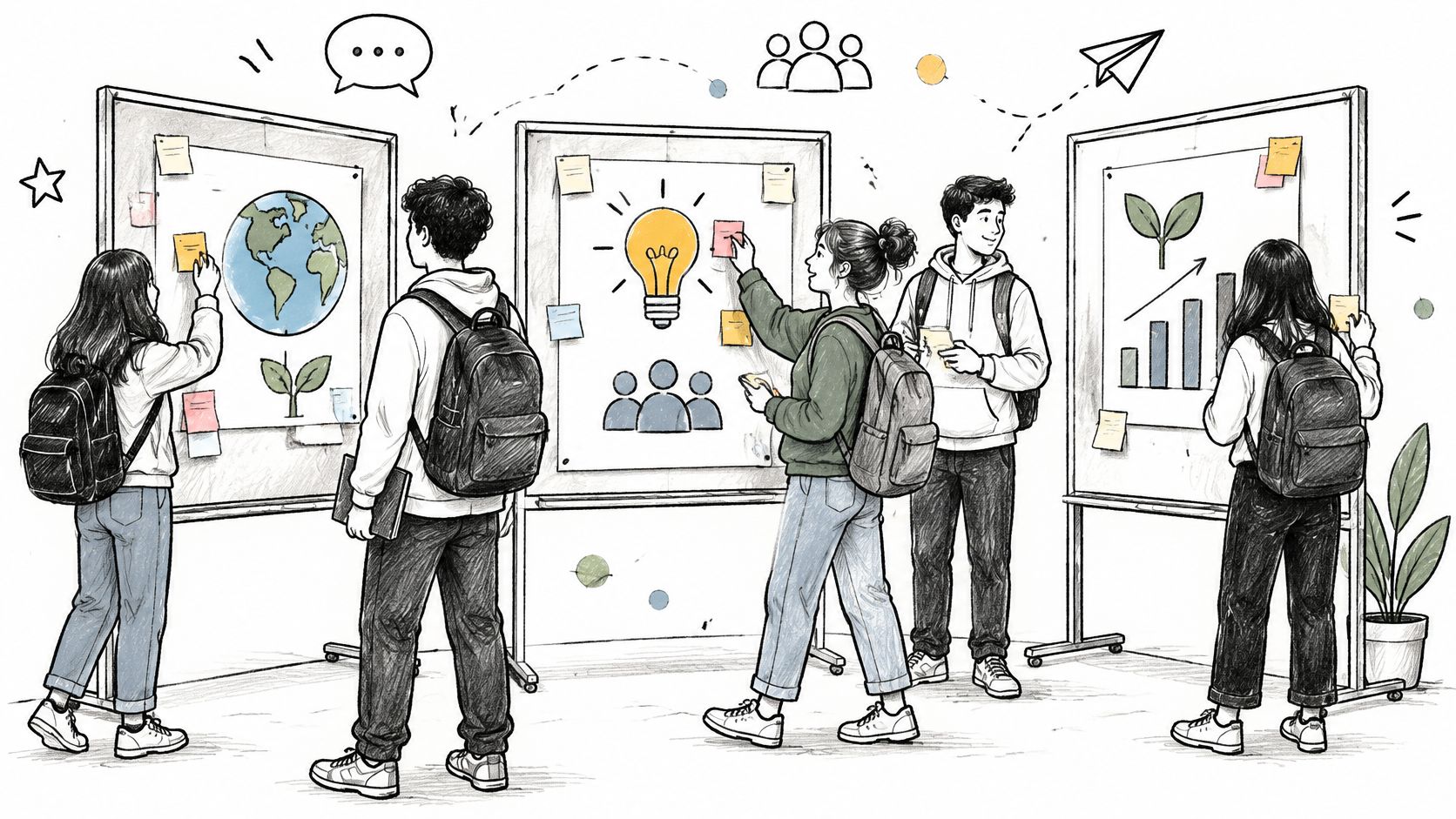
A gallery walk gives students a reason to inspect and respond to classmates' work. Posters, diagrams, source analyses, or proposed solutions become discussion stations rather than decorations.
In a science class, teams might display a hypothesis alongside a proposed investigation. Visiting students identify a missing control, an alternative explanation, or evidence the team would need before drawing a conclusion.
The movement isn't the learning task. Comparing ideas and making useful revisions are the tasks. Give visitors a focused response prompt so feedback goes beyond praise or disagreement.
- Set a lens: Ask visitors to examine evidence, assumptions, or the fit between a claim and its method.
- Require a reason: Comments should explain why a change would improve the work.
- Record a connection: Students note an idea from another station that affects their own thinking.
- Return to revise: Authors decide which feedback to use and justify that decision.
Assess What Students Do with Feedback
Assessment idea: Collect the original work, selected peer comments, and a revised explanation. Ask students to identify which suggestion they accepted or rejected and why.
This makes assessment less dependent on poster design or social confidence. It also discourages students from treating every peer comment as automatically correct.
For differentiation, bring station materials to students who can't comfortably move around the room. A seated exchange or accessible digital collection can preserve the comparison task without requiring physical rotation.
Provide readable copies rather than relying on photographs of handwritten posters. Text-to-speech can support access when the content is available as actual text, while diagrams need meaningful descriptions.
The trade-off is noise and divided attention. Stagger participation where needed, and give students a quieter route to review the same work without lowering the reasoning demand.

10. Audio-Based Review and Student-Created Podcasts
A student arrives having replayed the notes twice and still cannot state the main claim without the recording. Listening helps when reading is hard or inconvenient. It becomes active learning when the student stops to retrieve, explain, question, or apply what they heard.
Try this routine. Listen to one section of notes, pause, and explain the main idea without replaying it. Check that explanation against the source, then write a question that would test someone else's understanding. Audio access is useful. Listening time alone is not evidence that the student practised the target skill.
Produce an Explanation, Not a Read-Aloud
For a student-created podcast, explain a case study with a claim, supporting evidence, and a limitation. Record from a brief outline rather than reading a generated summary verbatim. Fact-check the recording before sharing it.
Printed books, notes, or printed text can be turned into audiobooks using smart scan technology. Click the Beta tab so listening continues without a break between sections. I treat that convenience as access, not as proof the student has studied.
Assessment idea: Ask listeners to submit a question and a source-based correction or extension. Assess the creator's accuracy, reasoning, and response to that feedback. Leave microphone quality and entertainment value out of the grade.
- Check the input: Review scanned text for recognition errors before converting it to audio.
- Inspect technical content: Confirm how headings, equations, tables, and references are read.
- Keep formats available: Offer text alongside audio so students can search, quote, and check details.
When speaking or recording is a barrier, accept a written explanation that still includes the claim, the evidence, and the limitation. Some students benefit from listening while following the text. Others need quiet reading or diagrams with clear descriptions.
Review on the go should stay safe and realistic. Save written responses and screen interaction for a suitable stop. Replaying a recording during another demanding activity is not focused study.
How the 10 Active Learning Strategies Compare at a Glance
| Item | Core Format | Setup Effort | Best For |
|---|---|---|---|
| Think-Pair-Share | Think individually, discuss with a partner, then share with the class | Low; needs a prompt and timing | Broad participation and quick discussion |
| Peer Instruction | Vote on a conceptual question, discuss with peers, then vote again | Moderate; requires strong questions and a voting method | Checking conceptual understanding, especially in STEM |
| Jigsaw Method | Learn in expert groups, then teach the material in home groups | High; requires materials, grouping, and time | Teaching multi-part or reading-heavy content |
| Problem-Based Learning (PBL) | Investigate an open-ended real-world problem and develop a solution | High; requires planning and facilitation | Building problem-solving and self-directed learning |
| Flipped Classroom | Study content before class; use class time for application and feedback | High; requires quality pre-class resources | Making class time more interactive and practice-focused |
| Reciprocal Teaching | Rotate student leadership through summarizing, questioning, clarifying, and predicting | Moderate; requires modeling and practice | Improving reading comprehension and monitoring understanding |
| Socratic Seminar | Discuss a text or question through student-led, evidence-based dialogue | Moderate; requires preparation and clear discussion norms | Critical thinking and close analysis of complex texts |
| Retrieval Practice with Low-Stakes Quizzing | Regularly recall information through short quizzes or other prompts | Low; requires consistent scheduling | Strengthening long-term retention and identifying knowledge gaps |
| Gallery Walk | Rotate among displays or prompts and respond at each station | Moderate; requires stations, space, and instructions | Sharing work and comparing multiple perspectives |
| Audio-Based Review and Student-Created Podcasts | Listen to course material and create spoken summaries or podcast discussions | Moderate; requires audio materials and basic guidance | Flexible review, accessible learning, and explaining ideas aloud |
Turning Active Learning into Your Next Study Session
Choose one strategy to test within the next week, using material you already need to learn. Think-Pair-Share is a practical starting point when you have a classmate available; a closed-note brain dump works when you're studying alone.
Start with the skill you'll eventually need to demonstrate. If your assessment requires solving unfamiliar problems, don't spend the whole session recalling definitions. If you need to evaluate research, practise identifying claims, methods, limitations, and competing explanations rather than only summarizing the abstract.
You also need a way to check your work. Before starting, identify an answer key, marking guide, reliable source passage, or instructor-approved example. Otherwise, you may finish an energetic discussion without knowing whether your explanation is accurate.
Build a Small, Repeatable Study Routine
Use a simple sequence that fits the task and your available energy:
- Select a manageable concept: Choose a mechanism, argument, procedure, or problem type rather than an entire course unit.
- Attempt it independently: Explain, solve, sketch, or predict before opening the answer.
- Check against evidence: Locate the exact step or relationship you missed.
- Revise your response: Produce a corrected explanation instead of merely rereading the solution.
- Return later: Attempt a related task without relying on the corrected answer in front of you.
Keep a brief record of recurring mistakes. A note that you confused correlation with causation tells you what to practise next; a record showing that you listened for a long time doesn't. Measure what you can explain or do, not only how much material you consumed.
Adapt the format before abandoning the strategy. If public discussion creates a barrier, try written exchange. If a group project exhausts your available energy, practise the same reasoning through a smaller individual case and seek feedback afterward.
Make Audio Part of the Routine
Students can turn printed notes into audio with TTS Reader Pro, available on iOS and Android. That can make preparation and review fit commutes, workouts, and other gaps in the day, while leaving demanding calculations or close source analysis for a suitable setting.
Choose a listening task before pressing play. You might plan to recall the argument at the next stopping point, identify a claim that needs checking, or explain how a concept connects to yesterday's lesson. When you can safely pause, attempt the response before listening again.
Don't introduce every strategy at once. Use the same approach across comparable topics, check your independent performance, and adjust the support you need. The useful question isn't whether the session felt busy or effortless, but whether you can now produce a clearer, more accurate answer without help.
Our TTS Reader Pro turns study notes, PDFs, articles, and scanned printed pages into audio for accessible review. Visit TTS Pro to bring a reading into your next study session, then pair listening with pauses for recall, explanation, and source checking.


No Comments
Leave a comment Cancel