
You've watched pronunciation videos for months, practiced along with them, and still get asked to repeat your name. That's frustrating, especially when you know the word well and can hear the difference in the recording. The problem may not be that you need more practice. It may be that you're practicing too many things at once, or copying the speaker's pace before your ear has picked out the sound that matters.
The useful goal is being easy to follow, not sounding like a newsreader. A strong regional accent is fine when listeners can hear the contrasts that distinguish your words. To learn pronunciation, first find the part of your speech that causes confusion, then work on one sound contrast, and only after that give your attention to stress and the tune of the phrase.
Table of Contents
- A Four Week Plan You Can Start Today
- Daily Drills for Sounds You Mix Up
- Stress Rhythm and Intonation Practice
- How to Judge Your Own Speech
- Fixes When Practice Stops Helping
- Choose a Model Voice and Begin
A Four Week Plan You Can Start Today
| Week | Focus | Done when |
|---|---|---|
| Week 1 Diagnosis | Record a short personal story. Listen once for consonants and once for vowels, then mark only three problem spots. | You can name the three sounds you miss. |
| Week 2 Consonants | One contrast, then shadow about eight lines. | A listener hears the contrast in new words. |
| Week 3 Vowels and stress | Long versus short vowels and the stressed syllable. | On a short retell, the important word is louder and longer. |
| Week 4 Rhythm and tone | Phrase stress plus falling or rising tone. | The Week 1 story is easier to follow. |
Use the schedule as a route, not a rule that you must start at the beginning. If your consonants are clear but your sentence stress makes you hard to follow, enter at Week 4. If listeners confuse two words, focus on the relevant sound contrast first. Repeating a diagnosis week won't help if you already know that the bigger obstacle is elsewhere.
Diagnose before you drill
In the first week, record about a minute of a real story. Choose something you can tell naturally, such as how you got to work, what you cooked, or a small surprise from the week. Don't read a script. A spontaneous recording gives you useful evidence about the speech you use.
Listen once for consonants. Notice whether a sound disappears at the end of a word, or whether two different consonants seem to come out alike. Then listen again for vowels, especially in words that a listener might confuse. Mark only three problem spots. A long list can make every sound seem urgent, but most of those differences won't be the best place to begin.
Build a small practice loop
In Week 2, choose one consonant contrast and practice it in short pairs, then in a few useful lines. Keep your attention on that sound instead of trying to fix your whole accent. In Week 3, work on vowel length and the syllable that carries the word's main stress. Listeners use those cues to recognize words, so a clear vowel with misplaced stress may still be difficult to understand.
In Week 4, practice phrase rhythm and tone. Ask whether the important words stand out and whether your voice falls or rises in a way that fits the message. Then tell the Week 1 story again. Compare the new recording with the first one for ease of understanding, not for whether you sound like a different person.
Weekday practice can stay near fifteen to twenty-five minutes, with one longer weekend pass if that suits you. A short, focused routine is easier to repeat than a session that tries to cover every sound. Learners who want a way to revisit material over several sessions can use this guide to spaced repetition for language learners, adapting the review intervals to their own schedule.
Listener test: Ask someone who doesn't share your first language to repeat the key words they heard, without guessing from context.
If they can pick out the words that matter, your practice is serving its purpose. You don't need to erase every feature of your accent to pass that test.
Daily Drills for Sounds You Mix Up
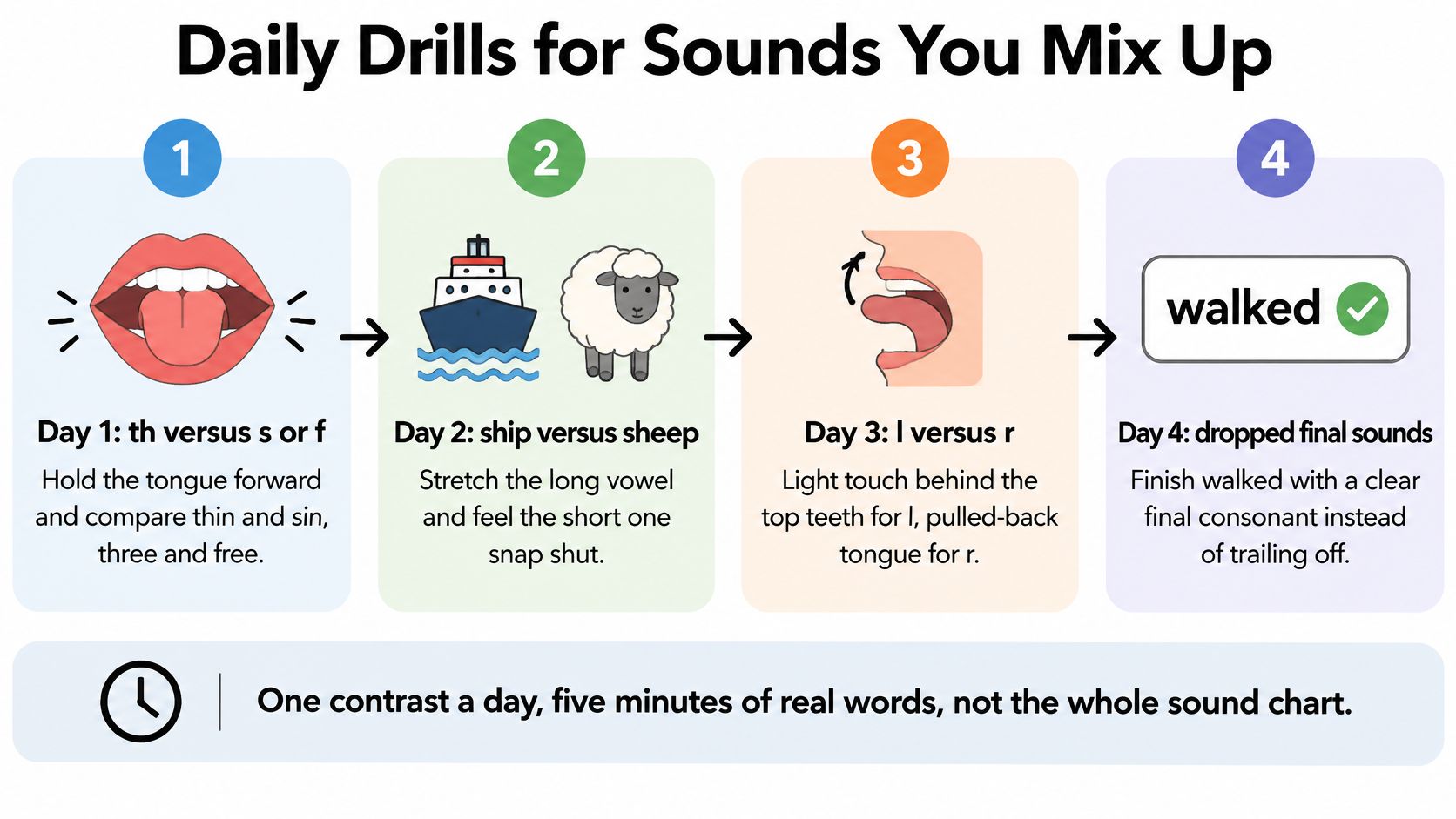
Choose one consonant or vowel contrast for the day. Don't turn a focused session into a tour of the entire sound chart. If ship and sheep blur together, practice that pair; if the ending of walked disappears, work on final consonants. The aim is to train your ear to notice a difference and your mouth to produce it on purpose.

Six moves for one contrast
Choose a pair and make a small word list. Write six words for each side of the contrast. For ship and sheep, you might sort words such as sit and seat, or live and leave. A list gives you more than one chance to hear the feature, while keeping the day's target narrow.
Check what your mouth needs to do. For the English th sound, let the tongue tip come between the teeth; compare it with the tongue position for s or f. For l, touch the tongue tip up behind the top teeth. For the vowel in food, round your lips and draw your tongue back. A mirror can help you see a movement, but the main check is whether your mouth makes the intended sound.
Say each pair slowly five times. Exaggerate the one mouth movement you're working on, then ease back toward an ordinary speaking shape. Don't rush to sound natural. If you haven't made the contrast clear slowly, speed is likely to blur it again.
Test your listening before you copy. Hide the list and play a model saying one word. Point to which side you heard before repeating it. This makes you decide what you heard, rather than letting your mouth imitate a vague impression.
Shadow eight short lines. Play a line, then say it with the recording. Start around eighty percent speed if the model moves too quickly. Match the target sound, not the speaker's personality, accent, or pitch. Cold speed-matching often fails because your ear follows the melody of the sentence and skips the consonant you meant to practice.
Record new sentences and score only the target. Speak for about thirty seconds using the sound in fresh sentences. Mark only misses of that sound. If you're practicing a final consonant, for example, check whether you finished walked rather than letting it trail off into walk.
Take the sound into the day
Reuse the same contrast in real situations instead of switching targets as soon as the drill feels familiar. On a commute, say a pair or listen for it in a short line. At a café, use a sentence that includes the sound when you place your order. In a work standup, make a point of using it in the sentence you contribute. These are opportunities to notice the sound during ordinary speech, not performances you need to get perfect.
If you practice th versus s or f, pay attention to whether you can maintain the tongue position inside a full phrase. If you're working on a dropped ending, carry the final consonant into the next word when you say a sentence. A sound that appears only in a list hasn't yet become useful in conversation.
Park every other error until this contrast is stable in new words. That doesn't mean those other features never matter; it means each one gets attention in turn. Once the current sound is clear beyond the memorized pair, choose the next target based on the words that still cause confusion. For more examples that bring isolated sounds into phrases, try these connected speech drills for clarity.
Stress Rhythm and Intonation Practice
You can pronounce each word clearly and still sound abrupt or be hard to follow if the words all receive the same weight. English listeners use stress and the shape of a phrase to notice what matters. Practice those cues after you've given the individual sounds some attention.
Make word stress audible
Say PHOtograph, phoTOGrapher, and photoGRAPHic. The family resemblance is clear in writing, but the strongest syllable moves from word to word. A similar shift happens in REcord as a noun and reCORD as a verb. If you give every syllable equal time, a listener may need an extra moment to work out which word you mean.
Tap or clap only the strong syllable. Then say the weaker syllables more quickly and at a lower pitch, without swallowing them. The tap isn't meant to turn speech into a song. It gives your mouth a physical cue to stop distributing emphasis evenly.
Now try the sentence, “I didn't say he stole the money.” Keep the words the same, but move the strongest emphasis:
- I didn't say he stole the money. This can deny that you were the person who said it.
- I didn't say he stole the money. This denies the act of saying it, while leaving room for another possibility.
- I didn't say he stole the money. This points away from him as the person who did it.
- I didn't say he stole the money. This can suggest that something else was taken.
The precise implication depends on context, but each version directs the listener toward a different contrast. Try the four versions and name what the emphasized word sets against the rest. That naming step keeps you from treating stress as a vague instruction to “sound more natural.”
Give phrases a clear tune
For this practice, use a falling voice at the end of a finished statement or a wh-question, such as “Where did you put it?” A yes-no question often rises at the end: “Did you send it?” A list can rise while it remains unfinished, then fall on the last item: “I need coffee, fruit, and bread.” These are useful starting patterns, not rules that erase the effects of context, emphasis, or the speaker's variety of English.
Pick three lines you might say in ordinary life: a short meeting line, a voicemail, and one sentence from a story. First, identify the word you want the listener to notice. Then say the line with that word prominent and the ending moving in the direction that fits your meaning. Keep the message conversational.
Don't copy a cartoon version of another accent. Practice the stressed word and the final fall or rise, not a whole new voice.
For extra phrase practice, connected speech drills for clarity can give you more examples of sounds in context. Use them to notice how words connect, while keeping your own intended message at the center.
Finish with a twenty-second retell of something that happened recently. Score only this: Was the important word louder and longer than the surrounding words? If yes, the listener has a helpful cue. If not, choose the key word and try again, without judging every part of your voice at once.
How to Judge Your Own Speech
“Do I sound better?” is a frustrating question because it asks you to rate your entire voice at once. A better question is, “Did I make this week's target easier to hear?” That gives you something specific to listen for and a result you can write down.
Use a one-feature score
Record the same short story you used for your starting sample. Listen once without looking at a script, and mark words you can't identify. Listen again with the script and tally only the target you've been practicing, such as a particular consonant contrast or the main stress in a word.
A useful measure is misses per thirty seconds of speech. It describes what happened in the recording without turning the result into a judgment about your accent. If you changed targets recently, keep the score for the old target separate. Otherwise, you won't know whether the number changed because your speech improved or because you were listening for something different.
Stop after two listens. Replaying the same recording again and again can make you search for faults instead of checking the feature you chose. If you find an unclear word on the first listen, use the script on the second to locate the target. Then record the result and move on.
Give a partner one clear job
A partner doesn't need to assess how your accent sounds. Give them a small listening task. For a minimal pair, say one word and ask them to point to the word they heard. For stress, ask them to write down which syllable sounded strongest. That tells you whether your contrast or emphasis was audible to someone else.
You might exchange five minutes of listening with a language partner, ask a classmate who doesn't share your first language, or send a voice note to a patient colleague. Give them the same narrow task and ask them not to comment on whether your accent sounds charming, foreign, or native. Those impressions don't tell you whether the specific word was clear.
Know what not to count
Ignore one-off slips that happen while you're telling an unfamiliar story. They matter less than a sound you miss repeatedly, especially when listeners confuse the word. Also ignore a vague tip that asks you to change many sounds at once. It doesn't give you a practical next step.
If your score stays flat across five sessions, don't add more drills automatically. The target may cover too much, or the listening model may be moving too fast for you to hear the feature. Narrow the contrast to a smaller pair, slow the model down, or use a shorter phrase. Make one adjustment, then check the same feature again.
Keep a simple log:
| Date | Target | Misses | One sentence to reuse tomorrow |
|---|---|---|---|
The sentence matters because it gives you a ready-made place to use the sound in ordinary speech. Write it in a way you might speak, rather than as a line designed only for practice.
Fixes When Practice Stops Helping
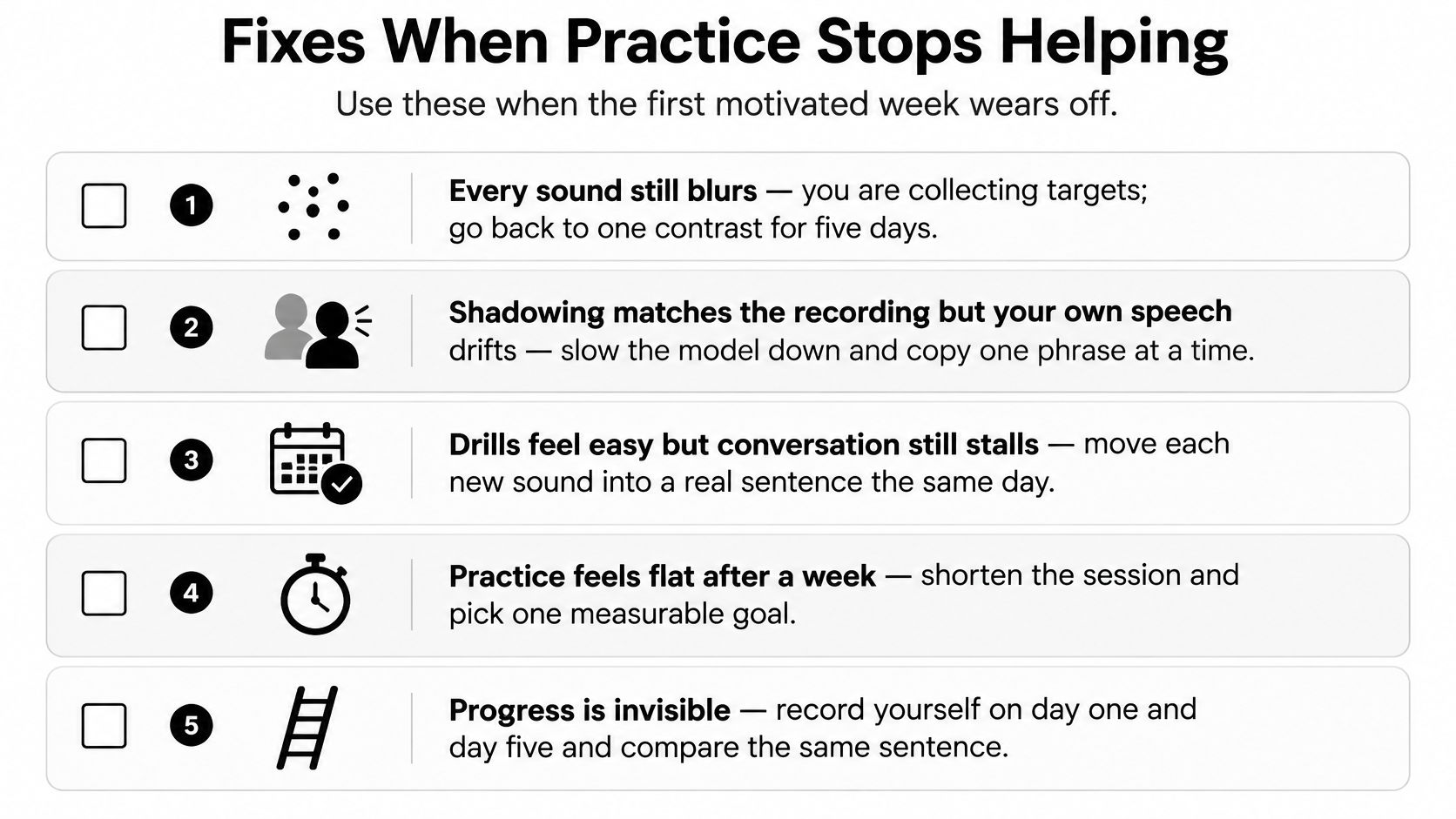
If every sound still blurs after two weeks, you may be collecting targets instead of learning one. Set the other concerns aside and stay with a single contrast for five days. It's easier to tell what is changing when you're not switching between a vowel, a final consonant, stress, and tone in the same session.

| What you notice | Likely cause | Change this |
|---|---|---|
| Every sound still blurs after two weeks | Too many targets at once | One contrast for five days |
| Shadowing copies speed but not the sound | Model is too fast | Slow the model and shadow the problem word plus the word before it |
| Mouth drills get skipped | Practice feels public and silly | Skip the public mirror session and make a private recording instead |
| Friends understand and strangers don't | Friends share your accent | Ask a listener outside your language group |
| You freeze as soon as you record | You're judging the whole accent | Score only the target sound, then delete the recording |
Change the cause, not the whole plan
Shadowing can look successful when you're matching the rhythm of a recording, even as you miss the consonant you meant to practice. If that's happening, the model is too fast for the task. Slow it down and copy only the problem word plus the word before it. That short unit gives you enough context to hear the transition without asking you to imitate an entire sentence at speed.
Mouth-position work may feel embarrassing if you're doing it where other people can watch. Skip the public mirror session rather than dropping the practice altogether. Make a private thirty-second recording and check whether the sound is distinct. You can return to the mirror when you have a reason to see a movement, not because you think every drill requires one.
Friends may reassure you that you sound fine, while a barista or new colleague keeps asking for a word again. Your friends may be familiar with your accent and able to predict what you mean. Ask a listener outside your language group to complete a simple task, such as choosing which word they heard. That gives you a clearer check than asking whether your speech “sounds good.”
Keep recordings from becoming a verdict
If you freeze when you record, choose one feature to score and delete the file after you tally it. You don't need a permanent archive of every practice attempt. The recording is a temporary tool for noticing whether one sound, syllable, or phrase cue landed.
If a sound is clear in a drill but disappears in conversation, the drill hasn't reached the situation where you need it. Use the sound in a café order, a meeting contribution, or a work standup line that same day. The sentence should be short enough to remember, but natural enough that you might say it.
Some adjustments take only one session, such as slowing an audio model. Others, like staying with one contrast long enough to use it in unfamiliar words, need repeated practice across the week. Don't respond to every stall by replacing the routine. Change one variable, make a fresh attempt, and check whether that specific change helped.
Choose a Model Voice and Begin
You don't need a perfect teacher before you can start. You need a model you can hear clearly and a way to tell whether your own target sound matches it. Choose one English voice for the week, then use that voice consistently. Familiarity makes it easier to attend to the sound rather than spending each session adjusting to a different speaker.
A useful model doesn't have to be the voice you want to imitate in every way. Listen for the target feature: perhaps the difference between ship and sheep, the end of walked, or the stressed syllable in a word. Keep your own accent and speaking style. The model is there to make a particular contrast easier to hear, not to give you a new identity.
Make replay easy
When you don't have a human partner to read practice lines, text-to-speech can supply repeatable audio. TTS Pro has several voice choices and adjustable listening speeds, so you can hear a line slowly and then bring it closer to conversation pace. Choose one clear English voice for the week. Keep it as your listening model while you work on the target, rather than changing speakers each time you replay a line.
You can enter the six pair words, short practice lines, or a note as text and replay them for shadowing. You can also use the same voice for a café order, a standup line, and a meeting sentence, so the sound moves beyond a word list. TTS Pro can convert text and supported document formats into speech; its voices are also available in multiple languages, including English. A free version is available for trying the listening workflow.
Take three actions today
- Record your personal story. Speak for about a minute, listen once for consonants and once for vowels, and circle one problem spot.
- Book a short practice session for tomorrow. Give it fifteen minutes and work on that contrast only, using the six-move drill.
- Choose one listening voice. Keep it for the week, and replay the same target in words and in a useful sentence.
That's enough to begin. One sound, one voice, and one recorded story give you a specific next step without requiring you to rebuild your accent.
TTS Pro offers replayable speech from text, with several voice choices and adjustable listening speeds. Use it to hear a pronunciation model at a manageable pace, then practice the same sound in a line you might say at work or in a café. Visit TTS Pro to try it as a listening and shadowing tool.


No Comments
Leave a comment Cancel